Profit on Paper, No Money in the Bank!
Why Profitable Businesses Still Struggle with Cash Flow
Beyond the Balance Sheet — Insights by CA Vandana V. Dodhia
“Madam, our Profit & Loss Account shows a healthy profit. Then why is there hardly any money in our bank account?”
A business may report rising sales, healthy margins and a respectable net profit, yet struggle to pay suppliers, salaries or statutory dues.
This is one of the most important questions a business owner can ask.
How is that possible?
Profit is what a business earns. Cash flow determines whether it can meet its payment obligations.
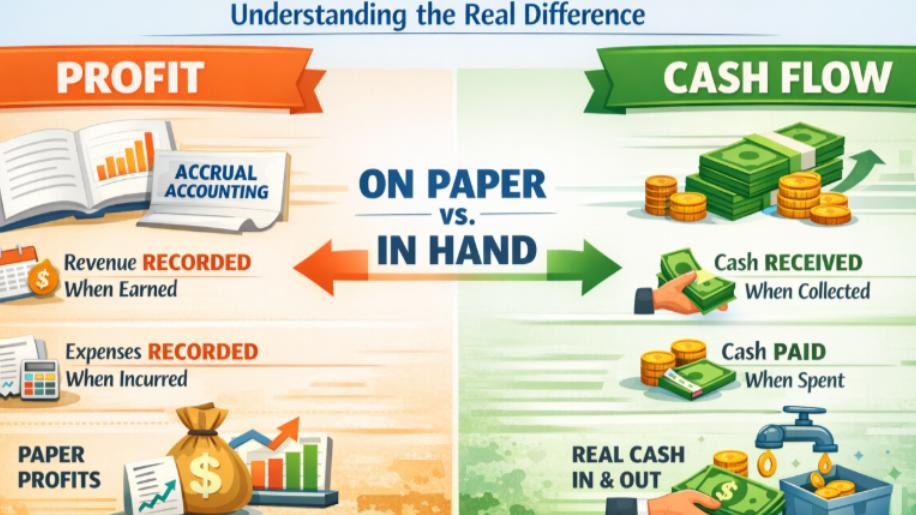
Both matter, but they tell different stories.
1. Sales Are Not Always Cash
Imagine a trading business reporting annual sales of ₹2 crore and net profit of ₹20 lakh.
On paper, the business appears financially healthy.
But suppose ₹60 lakh remains outstanding from customers, including several invoices overdue by months.
Sales have been recognised, but the corresponding cash has not reached the bank account. Meanwhile, salaries, rent, supplier payments and operating expenses continue.
This creates a gap between accounting profit and available cash.
Business insight: A profitable sale does not necessarily create immediate liquidity.
2. Inventory Can Quietly Consume Cash
Consider a business purchasing additional inventory in anticipation of higher demand.
The stock appears as an asset in the Balance Sheet, but cash has already been committed towards acquiring it.
If goods remain unsold for months, working capital gets blocked.
Regular stock reviews, inventory ageing and purchasing analysis can help identify slow-moving items and unnecessary accumulation.
Business insight: Inventory sitting in a warehouse represents money waiting to return to the business.
3. Loan Repayments Affect Cash Differently
Loan repayments are another frequently overlooked reason for cash shortages.
When a business pays its loan instalment, the interest component generally affects profit, while repayment of principal reduces the loan liability.
However, both components require cash.
Similarly, purchasing machinery may require substantial cash immediately, even though its cost is generally recognised over time through depreciation.
A business can therefore remain profitable while experiencing liquidity pressure.
Business insight: Not every cash outflow appears as an expense in the Profit & Loss Account.
4. The Working Capital Trap
As businesses grow, they often require additional working capital.
Higher sales may bring increased customer credit, larger inventory requirements and greater operating expenditure.
Ironically, rapid growth can create cash shortages even when profits are rising.
The cash conversion cycle helps businesses understand how long funds remain tied up in inventory and receivables, after considering supplier credit.
Business insight: Sustainable growth requires disciplined working capital management.
5. Five Questions Every Business Owner Should Ask
Beyond reviewing monthly profits, management should regularly ask:
- How much is outstanding from customers, and what portion is overdue?
- Which inventory items are moving slowly?
- What payments must be made over the next 30–60 days?
- How much cash is committed towards loan repayments and capital expenditure?
- Will expected collections cover upcoming obligations?
A rolling 13-week cash flow forecast can provide valuable early warnings.
Even a simple spreadsheet, supported by accurate accounting data, can become an effective management tool.
From My Desk: The Number That Deserves Attention
Over the years, one lesson has become increasingly clear to me:
A business should celebrate profits, but it must monitor cash.
A healthy Profit & Loss Account is encouraging. Financial stability, however, also depends on timely collections, disciplined spending, inventory control and planning future obligations.
Accounting software such as TallyPrime provides information on receivables, payables, bank balances and inventory. Reviewing these reports together can help identify liquidity pressures before they become serious.
Technology provides information. Management decisions turn that information into action.
The Way Forward
Profitability measures business performance. Cash flow determines whether the business can meet its financial commitments when they fall due.
The next time you review your Profit & Loss Account, don’t stop at the net profit figure.
Also examine receivables, inventory, liabilities and expected cash movements.
Because a business can survive a temporary dip in profit, but it cannot ignore a continuing shortage of cash.
CA Vandana V. Dodhia
Founder & Managing Partner
Vandana V. Dodhia & Co., Chartered Accountants
Beyond the Balance Sheet is a weekly knowledge-sharing initiative exploring practical ideas in accounting, technology, governance and business growth.
Disclaimer: This article is for general educational purposes. Illustrations are hypothetical. Financial treatment depends on the applicable accounting framework and facts of each case.